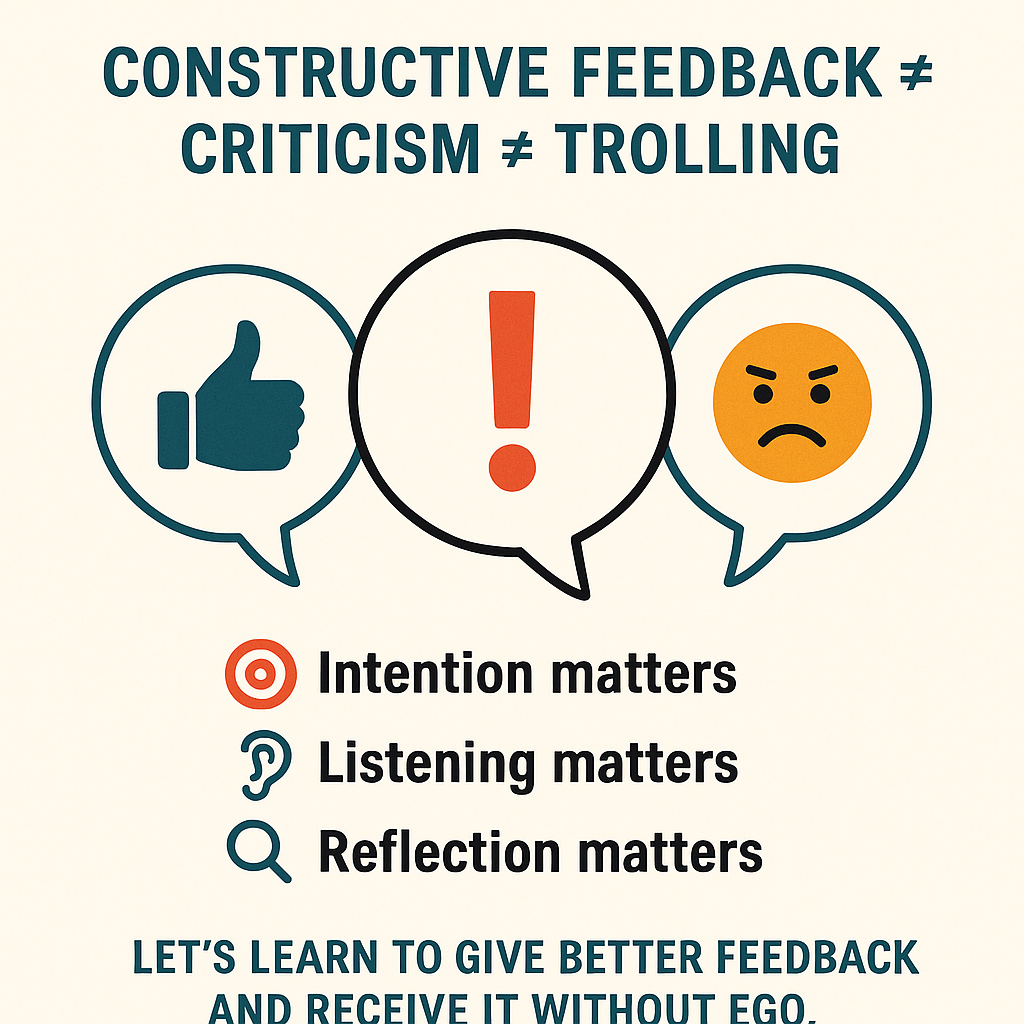
There have been moments in my professional life where a little constructive feedback—delivered with clarity and care—could have changed everything for the better. Instead, silence won. While it may have felt polite in the moment, I know an opportunity was missed and it was ultimately unhelpful.
I keep this lesson close to my heart and try to provide constructive feedback as soon as possible. This avoids me simmering away and the other person continuing on oblivious when it’s negative. When there is something really good to highlight, it’s a pleasure to see the lift in the person’s demeanour and motivation.
Why don’t we give feedback?
When I looked back, it made me wonder—why do people keep quiet instead of sharing feedback? And why do they get it wrong when they try?
- Fear of a negative reaction or outburst?
- A lack of skill in starting such conversations?
- A lack of experience?
- Not wanting to hurt someone’s feelings?
- Perhaps it’s more comfortable discussing your fails (and wins) with others, but not with you. This is merely gossip.
Withholding useful, considered input, especially in professional environments, doesn’t help anyone grow. It also creates atmospheres, which absolutely do not help develop healthy environments and teams.

Bill Clinton on a Masterclass on Intentional Leadership
states
“It’s amazing how liberating it is to welcome criticism.”
Hell yes! When someone gives you thoughtful feedback and you suddenly see how you can improve your work, presentation, teamwork—or anything else—it’s energising.
Is all useful feedback negative?
Has cancel culture framed all feedback and reviewing in negativity? When someone is asked to provide feedback—whether in a survey, research interview or face-to-face—they often feel compelled to highlight weak spots.
It’s almost like our desire to appear knowledgeable means we must find something to improve. Meanwhile, giving both praise and critique is now discouraged in case the message gets diluted.
“Our enemies are our friends because they show us our faults.” – Benjamin Franklin
Awareness of our weak spots is useful, but it shouldn’t be crippling. Others favour developing our strengths for success. So can we shout just as loudly when there are really good things to say too?
Criticism, critique, or feedback?
Let’s clarify definitions:
- Criticism: “The expression of disapproval of someone or something on the basis of perceived faults or mistakes.”
- Critique: “Evaluate (a theory or practice) in a detailed and analytical way.”
- Feedback: “Information about reactions to a product, a person’s performance of a task, etc. which is used as a basis for improvement.”
Let’s break them down:
| Constructive Feedback | Criticism | Trolling |
|---|---|---|
|
|
|
Intention matters
Before giving feedback, ask yourself:
- Am I doing this to help?
- Is this about them, or about me?
- Am I the right person to give this feedback?
- Am I doing it at the right time, in the right way?
- Is it useful—or am I just venting?
- Do I have something specific to say?
If your motivation is spite, ego, or manipulation—bite your tongue.
Listening matters
Receiving feedback isn’t always easy. Discomfort is part of growth. Active listening means resisting the urge to react or defend.
You can simply say: “Thanks for taking the time to tell me this, I’ll give it some thought.”
- Don’t react immediately
- Listen fully—even if it stings
- Reflect on what was said
- Consider the source
Not all feedback needs to be acted on, but all of it can be considered. Take criticism seriously, not personally.
The silent trap
Feedback often gets withheld until formal reviews—when it’s too late to improve. That silence can stem from:
- Fear of damaging relationships
- Social discomfort or politeness
- Lack of skill or experience
- Workplaces without a feedback culture
But silence isn’t golden. It’s a barrier to growth.
When people have given me thoughtful, timely feedback—even when it was hard to hear—it moved me forward. It improved our relationship. I felt energised, not criticised.
Build a feedback culture
We talk a lot about communication and public speaking—but what about feedback?
- Ask for feedback regularly
- Give it with kindness and clarity
- Receive it with curiosity, not ego
- Practise it with friends, family, co-workers
- Offer praise just as much as critique
- Be clear on your intentions
Creating environments where honest, constructive feedback flows freely is how individuals and teams thrive.
Sometimes the comment that stings is the one that helps you grow. Just as important is learning to be the person who gives feedback not to belittle, but to build.
References
Masterclass Inclusive Leadership, Bill Clinton
Radical Candor A book by Kim Scott